The short answer
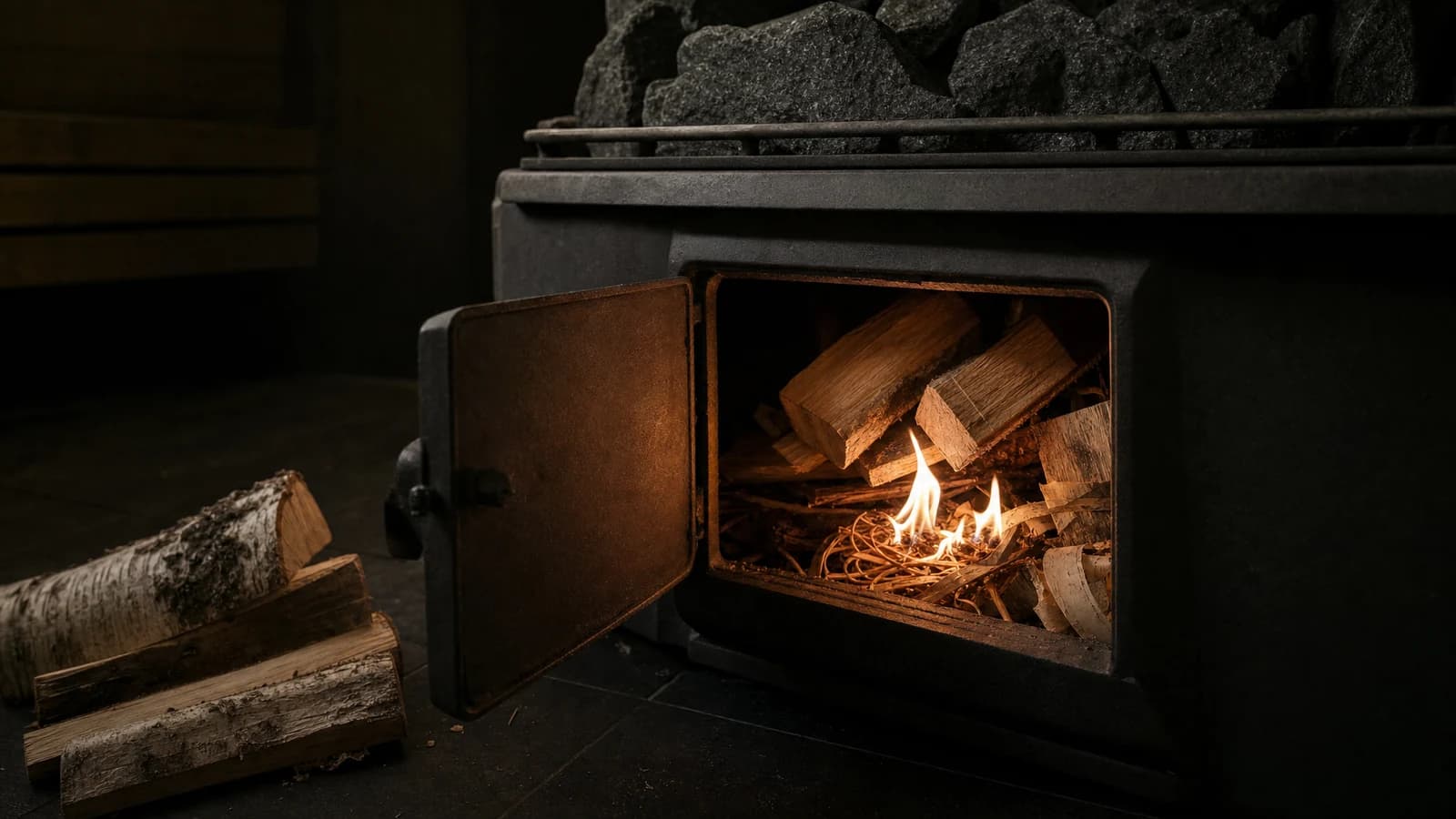
Dry split logs, stacked loosely, lit from the top. Largest logs at the bottom, thinner ones above, kindling and birch bark right on top. Damper and air vent open, door closed once the flame is steady. A fire burning downwards dries the wood beneath it as it goes, so it smokes less and draws at once.
What to know before your first visit
- Dry wood matters more than lighting technique. Damp wood smokes and does not heat.
- Stack loosely: fire needs air around every log.
- Light from the top, not the bottom — less smoke and steadier burning.
- Never use liquid firelighters. A sauna stove is not a barbecue.
Before you strike a match
Check three things. Is there so much old ash in the firebox that air cannot pass? A thin layer is good, a thick one is not. Are the damper and air vent open? Are there stones on the stove and are they sitting properly?[1]
Check the wood too. Dry wood is the single biggest variable — bigger than any lighting technique. A dry log is light, cracked at the ends, and rings when you knock two together. A damp one feels heavy and thuds.
With damp wood the sauna smokes, soots up and stays lukewarm, because part of the energy goes into boiling water out of the wood itself. No amount of clever lighting fixes that.
Stacking: loose, not tight
The commonest mistake is cramming the firebox full. Fire does not need much wood; it needs much air, with a gap around every log. A tightly packed firebox smoulders and smokes. A loosely packed one catches.
Lay the largest logs on the bottom side by side, thinner ones crosswise above them, and fine kindling and birch bark right on top. The stack narrows as it rises.
Which way the logs face depends on the stove. Some are loaded lengthwise to the door, some crosswise; the manufacturer's instructions say which. The principle is the same either way: loosely.[1]
Lighting from the top
Light the stack at the top, not underneath. It feels wrong at first, because instinct puts the fire at the bottom. But a flame working downwards dries and gasifies the wood below before it ignites, and that wood then burns cleaner.
The difference shows at the chimney: a bottom-lit firebox pushes thick white smoke for the first few minutes, a top-lit one almost none. Bottom-lighting does work — it just smokes on the way.
Leave the door ajar for a moment so the draught establishes, and close it once the flame is steady. After that the burn is controlled from the air vent, not by holding the door open.[1]
Open the damper and air vent
Without draught, no lighting method works.
Stack loosely, largest at the bottom
Leave a gap between logs. The stack narrows upwards.
Kindling on top
Fine splits and birch bark right on top of the stack.
Light from above
Door ajar until the flame is steady, then closed.
Add wood onto embers
When the flames drop, add logs onto the embers — do not refill the firebox.
Heating time, and how to tell it is ready
This page gives no number of minutes, because there is no such number. Heating time depends on the stove, the mass of stones, the volume of the room, the insulation, the wood and the outside temperature. A cottage sauna in February and the same sauna in July are different problems.
A ready sauna is recognised from the stones, not the clock. The stones need to be hot right through, not only on top. If water hisses briefly and stops, they are warm only at the surface and the fire keeps going.[1]
Never light with liquids. Firelighter fluid, petrol and spirit-based products do not belong in a sauna stove; the smell stays in the room and using them in a closed firebox is dangerous.
Practical answers
First-visit questions
How do you light a wood-burning sauna stove?
Stack dry logs loosely with the largest at the bottom, put kindling and birch bark on top, and light from above. Damper and air vent open, door ajar until the flame is steady.
Why light from the top rather than the bottom?
A flame working downwards dries and gasifies the wood beneath before it ignites, so there is far less smoke and the burn is steadier.
How long does a wood sauna take to heat?
There is no single figure. It depends on the stove, the stones, the room and the wood. The sauna is ready when the stones are hot right through, not when the clock says so.
Why does my sauna smoke so much?
Usually damp wood or a firebox packed too tightly. Check also that the damper and air vent are open and that there is no thick layer of ash inside.
Editorial review
Sources
- Suomen SaunaseuraThe sauna heater
- Suomen SaunaseuraSauna bathing and customs