The short answer
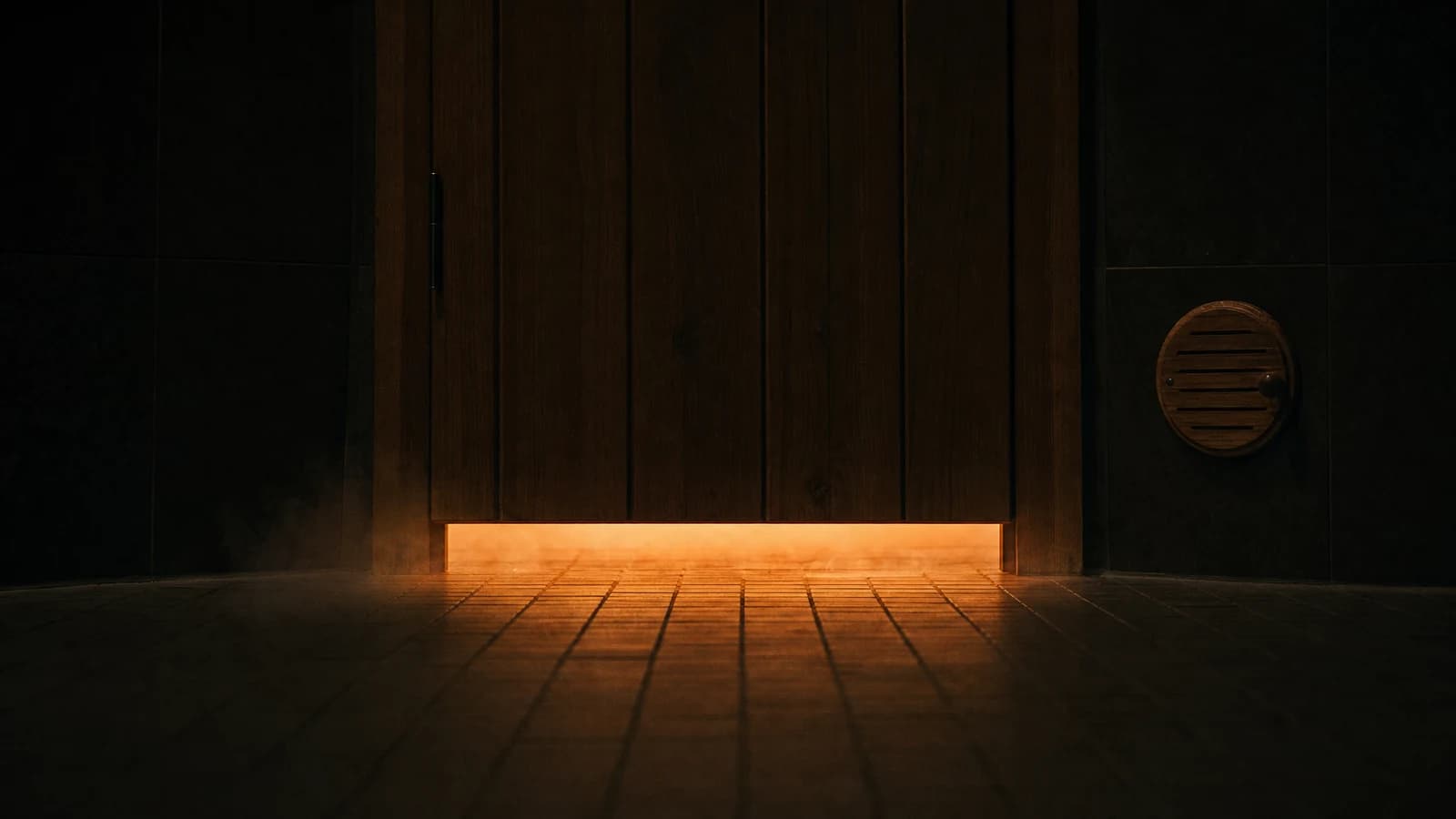
The gap is the exhaust. A sauna needs air moving through it continuously: fresh air enters near the heater, circulates through the room, and leaves — usually under the door or through a vent close to it. Without that circulation the oxygen drops, the air feels heavy and the löyly loses its edge, even when the thermometer reads correctly.
What to know before your first visit
- The gap is not a defect. It is the outlet half of the ventilation.
- Inlet and outlet work as a pair; one without the other does nothing.
- Feeling stuffy at the right temperature is almost always ventilation, not the heater.
- Do not block the gap with a towel, a mat or draught tape.
What the gap does
A sauna is not a sealed box, however much it looks like one. It is a room with air passing through it continuously, and the heater is what keeps that moving: hot air rises, cooling air falls, and something has to replace it.[1]
The gap under the door is the far end of that circuit. Through it leaves the air that has already been round the room: cooled, damp and lower in oxygen. The gap sits at floor level because that is where that air is.
In many saunas a wall vent near the floor or under the benches supplements or replaces the door gap. Constructions differ. What they share is an outlet low down and an inlet somewhere else.
The inlet is the other half
An outlet on its own does nothing. If the air has nowhere to come from, it has nothing to leave with. So a sauna also has an inlet vent, and it usually sits above the heater or immediately beside it.[1]
That position is deliberate. Cool air arriving next to the heater warms immediately and sets off around the room from the top down. If the inlet were at floor level, the incoming air would stay on the floor and the upper part of the sauna would go stale.
Which gives a practical rule: if a sauna feels stuffy, check both openings. The most common fault is a closed or painted-over inlet, not the gap.
Why a sauna feels stuffy at the right temperature
The thermometer says 80 °C and it still feels heavy, with breathing that takes effort. That is not a temperature problem. It is an air problem: less oxygen and more moisture than there should be, because the air is not being replaced.
The same goes for löyly. In a well-ventilated sauna the steam feels sharp and passes quickly; in a badly ventilated one it hangs and turns oppressive. The difference is not in the heater but in where the steam goes.[2]
If you start to feel unwell in a sauna, leave and cool down. Feeling bad in heat is not something to see through to the end.[3]
What not to do
Do not block the gap. A towel under the door, draught tape or a floor mat will remove the sensation of a draught and stop the whole circuit with it. The room may heat faster, but the air gets worse for the whole session.
Nor should you close the inlet vent to warm the room quicker. That is the same mistake from the other end.
One thing worth doing: leave the door ajar after bathing. It is the cheapest way to dry the benches and floor, and dry benches last years longer than damp ones.[2]
Practical answers
First-visit questions
Why is there a gap under the sauna door?
It is the ventilation outlet. Air that has already circulated — cooled, damp and lower in oxygen — leaves through it so fresh air can take its place.
Can I block the gap under the sauna door?
You should not. With the gap blocked the sauna stops exchanging air, and it goes heavy even while the temperature stays correct.
Where does fresh air enter a sauna?
Usually above the heater or immediately beside it, so the incoming cool air warms at once and sets off around the room.
Why does my sauna feel stuffy at the right temperature?
Almost always because the air is not being replaced. Check both the outlet gap and the inlet vent; the usual fault is a closed or painted-over inlet.
Editorial review
Sources
- Suomen SaunaseuraThe sauna heater
- Suomen SaunaseuraSauna bathing and customs
- TerveyskirjastoHeat illness and injuries caused by cold