The short answer
The heater's rating in kilowatts times the heating time in hours. A 6 kW heater running for an hour and a half uses about nine kilowatt-hours. Multiply that by your own electricity price for a figure in euros. The rating is on the heater's data plate, not in this article.
What to know before your first visit
- The formula is kW × h = kWh. Nothing else is needed.
- The rating is printed on the heater's data plate — usually 4.5–9 kW in home saunas.
- The thermostat cuts the power in between, so real consumption is often lower than the calculation.
- The cost in euros depends on your contract. No website can know that for you.
The formula, and why it is enough
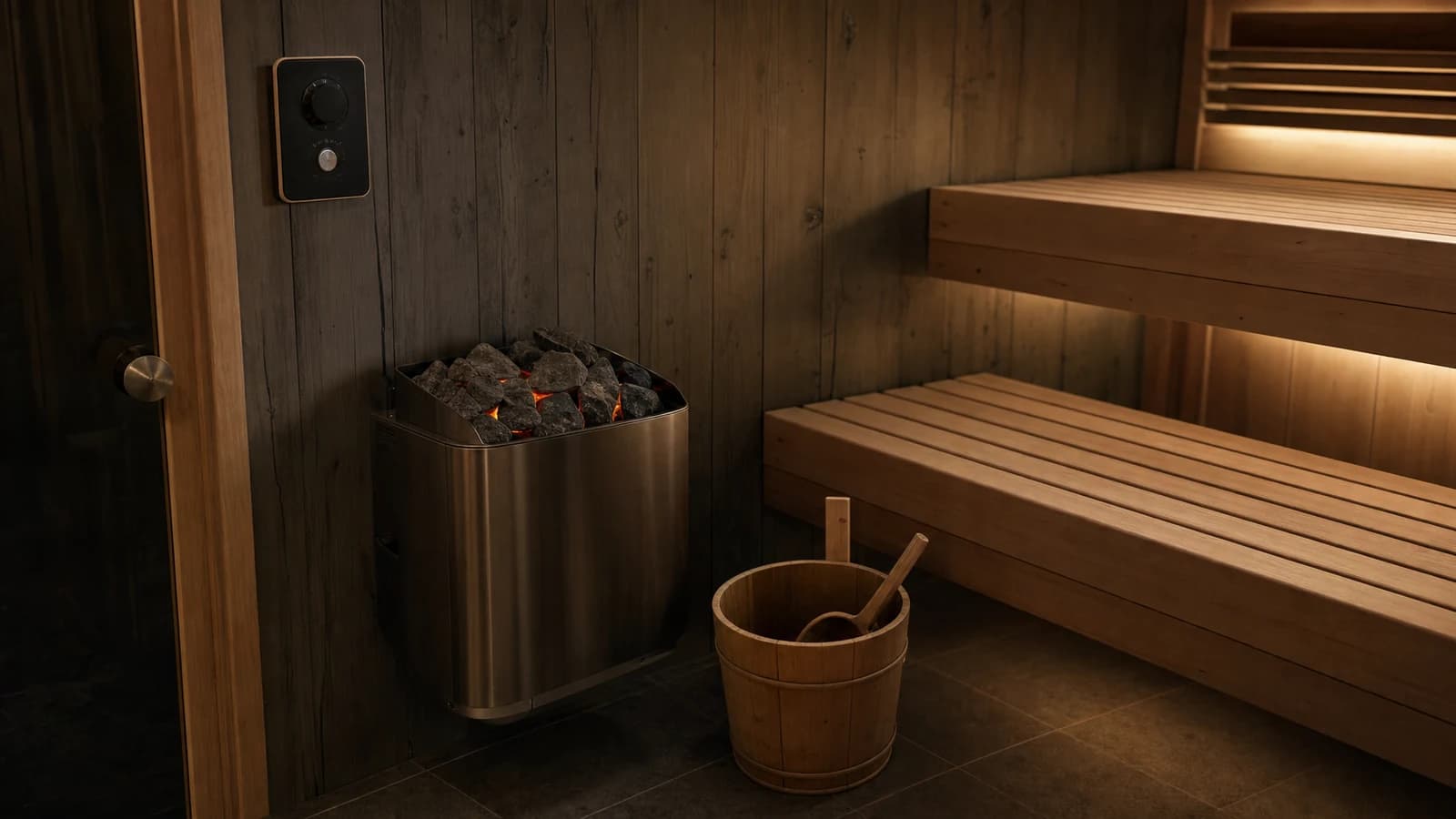
An electric sauna heater is a resistance element. It turns electricity into heat with nothing in between, so its consumption is simply its rating multiplied by the time it is on. A 6 kW heater at full power uses six kilowatt-hours per hour.
A worked example: 6 kW × 1.5 h = 9 kWh. If your electricity costs 12 cents a kilowatt-hour, that sauna cost about €1.08. If it costs 30 cents, it cost €2.70. Same sauna, same time, different bill.
Which is exactly why this page gives no euro figure. The price is a number in your contract, and on a spot-price tariff it changes hour by hour. The consumption is a number about your sauna, and it stays put.
Where to find your heater's rating
The rating is printed on the data plate, usually on the side or the lower edge of the heater. It will say something like 6.0 kW. That is the only number you need to look up.[1]
The rating is not arbitrary: it is matched to the volume of the room, roughly a kilowatt per cubic metre. A small home sauna manages on 4.5 kW; a typical family sauna is often 6–8 kW.[1]
Which leads to something that surprises people: a bigger heater does not automatically use more. An undersized heater runs flat out for longer to reach temperature. A correctly sized one gets there sooner and then starts cycling off.
Why real consumption comes in under the calculation
The formula assumes the heater is at full power the whole time. That is only true while it is warming up. Once the room reaches the set temperature, the thermostat cuts the elements and brings them back only when the heat drops.
So the calculation gives you an upper bound, not an exact figure. An hour of heating followed by an hour of bathing uses less than two hours at full power — but how much less depends on the insulation, the door, and how often it is opened.
If you want your actual number, it is in your electricity company's consumption data: heat the sauna once and look at that hour. That is the only measurement that is about your sauna.
What about a wood-burning stove?
A wood-burning stove uses no electricity at all, so none of this arithmetic applies. Its cost is the cost of the wood, and that depends on whether you buy it or cut your own.[1]
Heating with wood usually takes longer than with electricity, and it needs somebody present. You do not schedule it from a phone. That is part of why a cottage sauna is a different experience from a sauna in a block of flats.
Practical answers
First-visit questions
How much electricity does a sauna use?
The heater's rating in kilowatts times the heating time in hours. A 6 kW heater for an hour and a half is about nine kilowatt-hours.
How much does it cost to heat a sauna?
That depends on your electricity contract, and no website can know it. Work out the consumption in kilowatt-hours and multiply by your own price.
Where do I find my heater's rating?
On the data plate, usually on the side or lower edge of the heater. Home saunas are most often between 4.5 and 9 kilowatts.
Does a bigger heater use more than a small one?
Not necessarily. An undersized heater runs at full power for longer. A correctly sized one reaches temperature sooner and then cycles off on the thermostat.
Editorial review
Sources
- Suomen SaunaseuraThe sauna heater
- InfoFinlandFinnish sauna