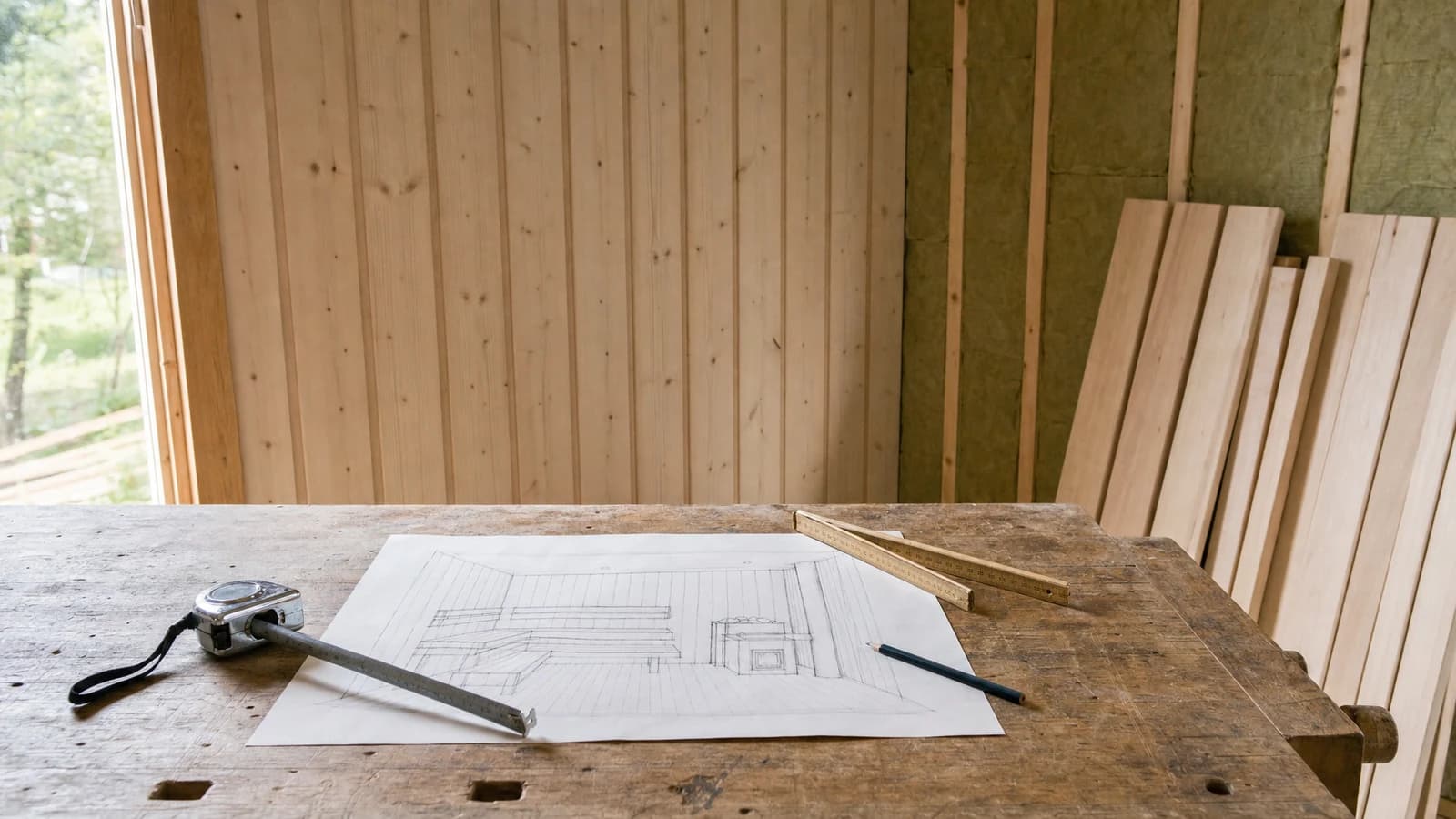
The short answer
The cost turns on five things: the volume of the room, whether it is a new space or a conversion, the type of heater and the electrical supply or flue it needs, the ventilation, and the materials. No figure can be given in advance, because four of those five depend on the site.
What to know before your first visit
- Volume decides the heater, and the heater decides the supply or the flue.
- Converting an existing room is a different job from building a new one.
- Ventilation is not a finishing touch; it runs through the structure.
- Whether a permit is needed is decided by the municipality, not by the builder or this page.
First variable: volume
Everything starts from the cubic metres of the room. Volume sets the heater's rating — roughly a kilowatt per cubic metre — and the rating decides whether an ordinary supply is enough or a dedicated circuit and heavier cable are needed.[1]
Which leads to something that surprises people: a few extra cubic metres can move the whole electrical job into another class. A small sauna and a slightly larger one are not linear in price.
Nor is it worth adding volume for safety's sake. A large sauna heats more slowly, uses more, and feels empty with two people in it.
Second variable: new space or conversion
Converting an existing room and building a new one are different jobs. In a conversion the walls, floor and drainage are already there, but they were built for something else; often most of the work is taking them out.
In a new space nothing is ready, but nothing is wrong either. It is usually more expensive and more predictable; a conversion is cheaper and more prone to surprises.
A third option is a separate building — a garden or lakeside sauna. Then foundations, a flue and possibly a permit come into it, and the work is closer to a small construction project than to a renovation.
Third variable: the heater and what it requires
An electric heater needs an adequate supply and installation by an electrician. A wood-burning stove needs no electricity at all, but it needs a flue — and a flue is structure, not equipment.[1]
The choice is not only taste. In a block of flats a wood stove is usually not an option. At a cottage with limited electricity it may be the only sensible one.
The heater's installation instructions also set minimum clearances to walls, benches and everything around it. Those figures affect how large the room has to be, so the heater is worth choosing before the benches are drawn.[1]
Fourth and fifth: ventilation and materials
Ventilation is not finishing work. The inlet and outlet are designed at the same time as the walls, because they pass through the structure. Added afterwards, the same thing is demolition.
With materials, price and experience travel together: panelling, benches and floor are the three where the choice shows and is felt every time. The cheapest panelling and the dearest do not cost the same and do not feel the same when hot.
This page gives no rates per square metre. Material prices move with the season, the supplier and the quantity, and a figure that was right here today would be wrong by spring.
Permits are decided by the municipality
Whether a permit is needed depends on what you are building and where. A change inside a dwelling, a separate building in a garden and a sauna on a shoreline are three different cases.
The answer comes from your own municipality's building control, and cannot be read off any general page — including this one. Distances to boundaries and to the shoreline are set locally.
Practical answers
First-visit questions
How much does it cost to build a sauna?
No price can be given without seeing the site. It depends on the volume, whether it is a conversion or a new space, the type of heater, the ventilation and the materials.
What decides the size of the heater?
The volume of the room, roughly a kilowatt per cubic metre. The rating in turn decides whether an ordinary supply is enough or a dedicated circuit is needed.
Do you need a permit to build a sauna?
It depends on what you are building and where, and the answer comes from your municipality's building control. Distance requirements are set locally.
Electric or wood-burning heater?
An electric heater needs an adequate supply, a wood stove needs a flue. In a block of flats a wood stove is usually not an option; at a cottage with limited electricity it may be the only sensible one.
Editorial review
Sources
- Suomen SaunaseuraThe sauna heater
- InfoFinlandFinnish sauna